Kling 4.0 on zzo.ai costs 160 credits ($1.60) for a 5-second 720p clip with audio. No subscription: buy credits once and they never expire.
Kling 4.0 is Kuaishou’s AI video model, officially launched on 15 October 2026. It makes clips of up to 30 seconds in one generation, with two-channel stereo sound, from text or a first-frame image. zzo.ai is an independent site that runs it; it is not Kling’s own app.
5–30 s clips
Up to 1080p
Sound included
Prompt from this video. Edit it or write your own.
With audio
Made with Kling 4.0
Each one shows the prompt, model and what it costs here. Pick one to start from it.
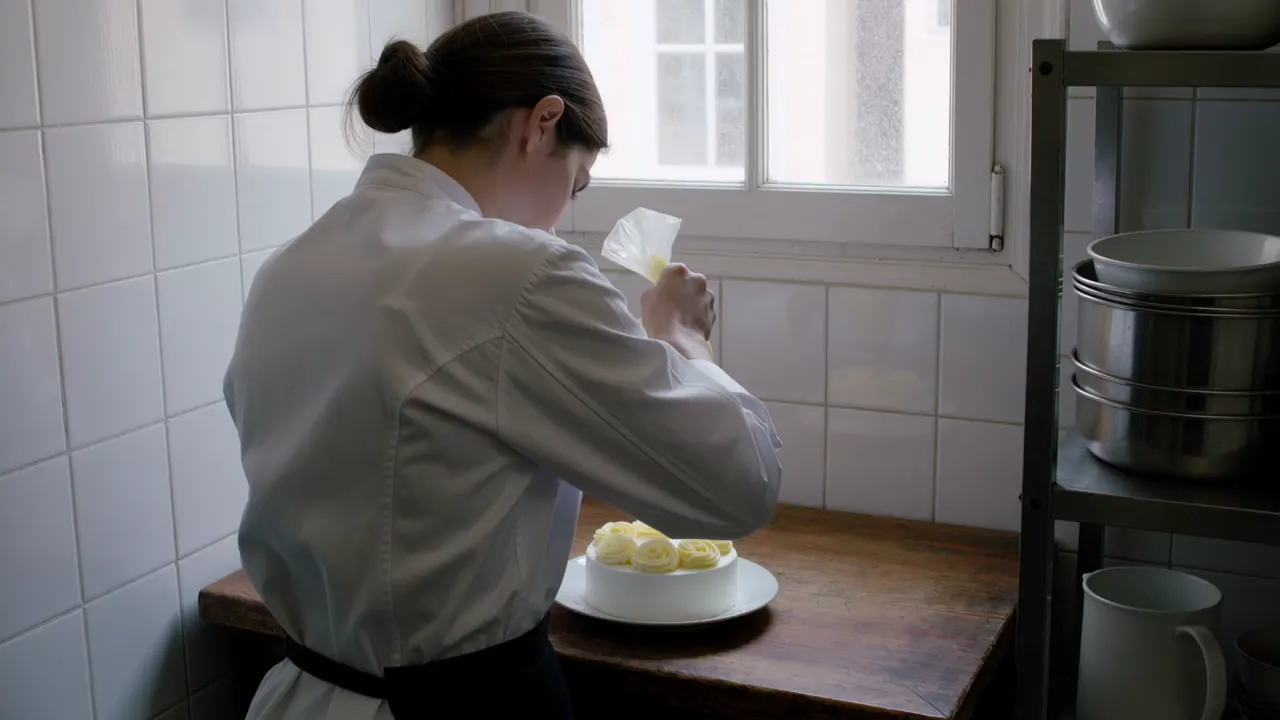
“One unbroken handheld take, direct-flash 35mm snapshot look, fine grain, white tile and bright window light. 0-5s: from behind, a young pastry cook in a white jacket and a long black apron pipes the last pale-yellow buttercream flowers onto a small white cake on a scrubbed wooden bench in a narrow tiled pantry, steel bowls stacked on the shelves. 5-10s: she puts the piping bag down, turns the cake once on its plate to check it from every side, and straightens one flower with a fingertip. 10-15s: she lifts the cake on its plate, turns and carries it through the cramped kitchen past hanging ladles and a steaming stockpot, the camera following at shoulder height. 15-20s: she shoulders open a back door into a quiet, sunlit courtyard and walks across the flagstones. 20-25s: she sets the cake down on a weathered table laid for one and steps back to look at it. 25-30s: she wipes her hands on the apron and walks back inside, leaving the cake alone on the table in the sun. Sound: piping bag squeeze, a pot lid rattling, the door creak, birds outside.”Kling 4.0, 30 s, sound, 1,410 credits, made on Kling AI
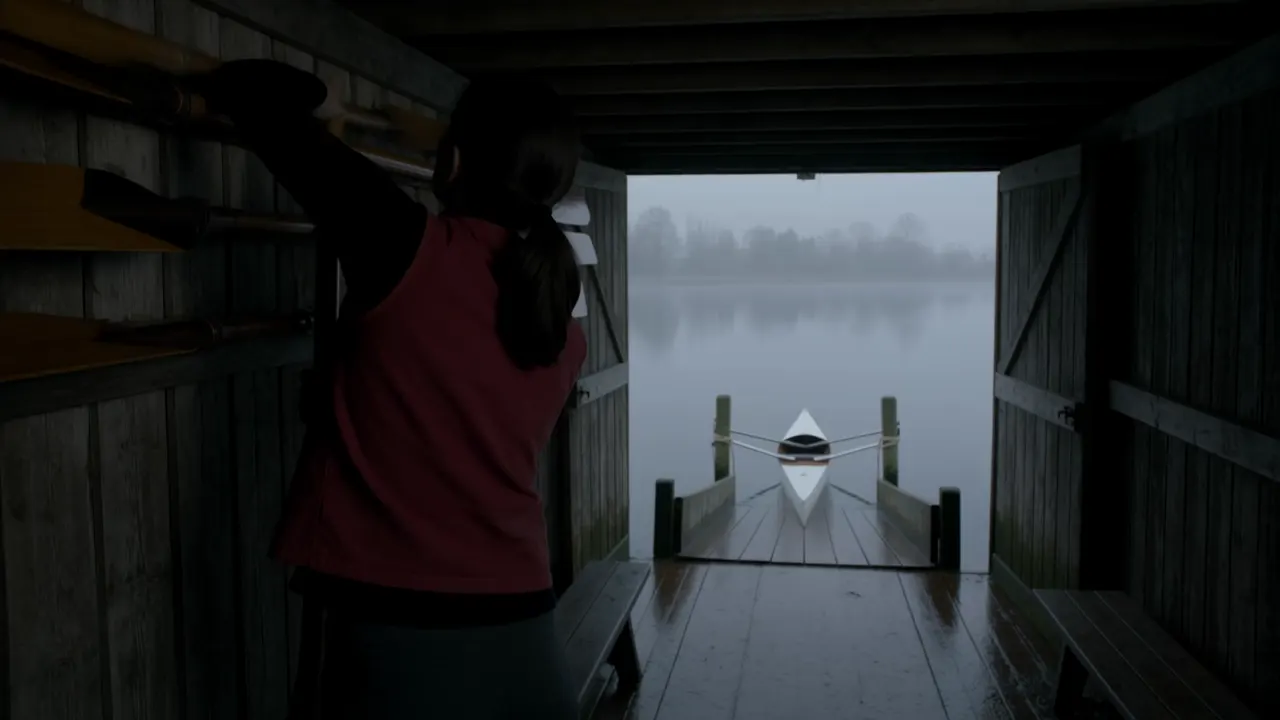
“One unbroken handheld take on 16mm film, misty grey dawn, a muted palette of wet timber, slate water and fog with one faded-red accent. 0-4s: inside an old timber boathouse on a still lake, a young woman in a faded red rowing vest and grey leggings lifts a pair of long wooden oars down from a wall rack. 4-8s: she carries the oars on her shoulder down the wet wooden slipway, the camera following behind her at shoulder height. 8-12s: she steps carefully into a narrow white single scull tied at the jetty, sits, and slots the oars into their riggers. 12-15s: she pushes off from the jetty with one hand and takes her first stroke, the scull gliding out into the fog, ripples spreading toward the camera. Sound: creaking boards, her footsteps, water lapping, one distant bird call.”Kling 4.0, 15 s, sound, 705 credits, made on Kling AI
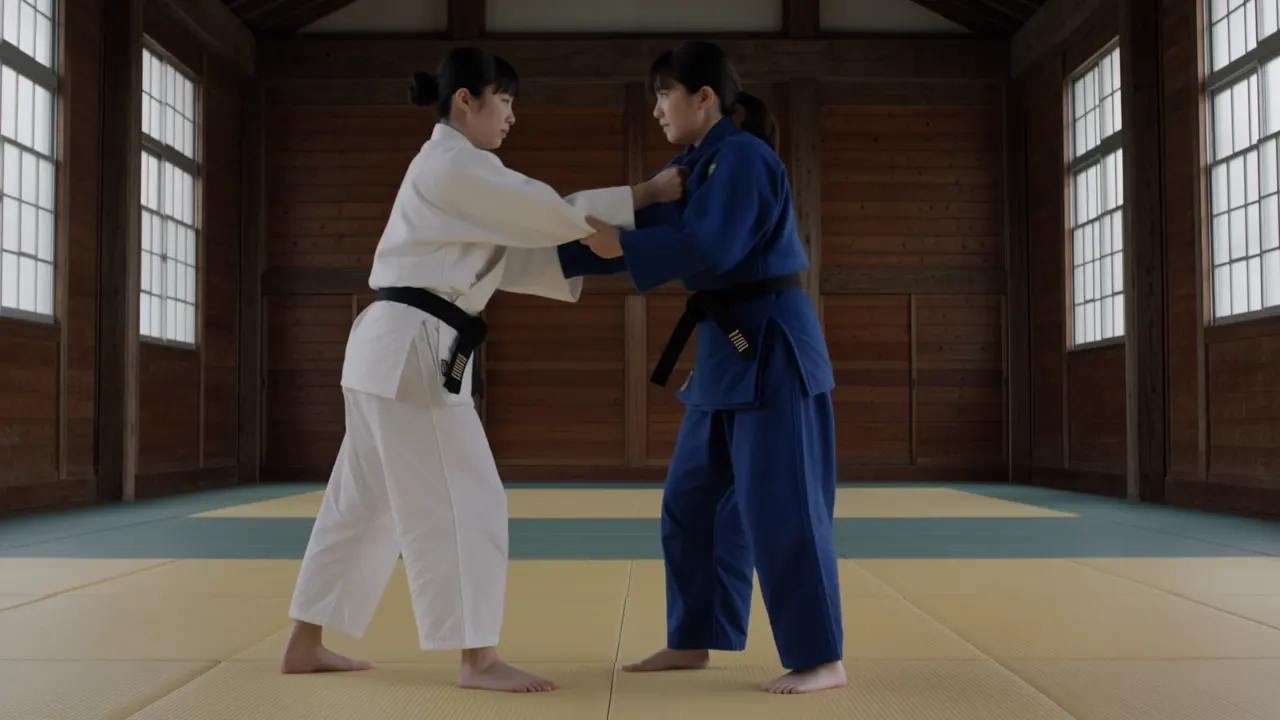
“Real-time speed, 35mm documentary look, flat daylight from tall paper windows in an old wooden dojo with straw-yellow tatami. Two women judoka, one in a white judogi and one in a deep blue judogi, grip each other's lapels and sleeves. The woman in white steps in, turns her hip under her opponent and throws her in a clean hip throw; the woman in blue rotates over her hip through the air, lands flat on her back with a loud slap of the mat and immediately rolls up to her knees. Camera: low handheld, side-on, following the throw. Sound: bare feet on tatami, a sharp exhale, the slap of the landing.”Kling 4.0, 5 s, sound, 235 credits, made on Kling AI
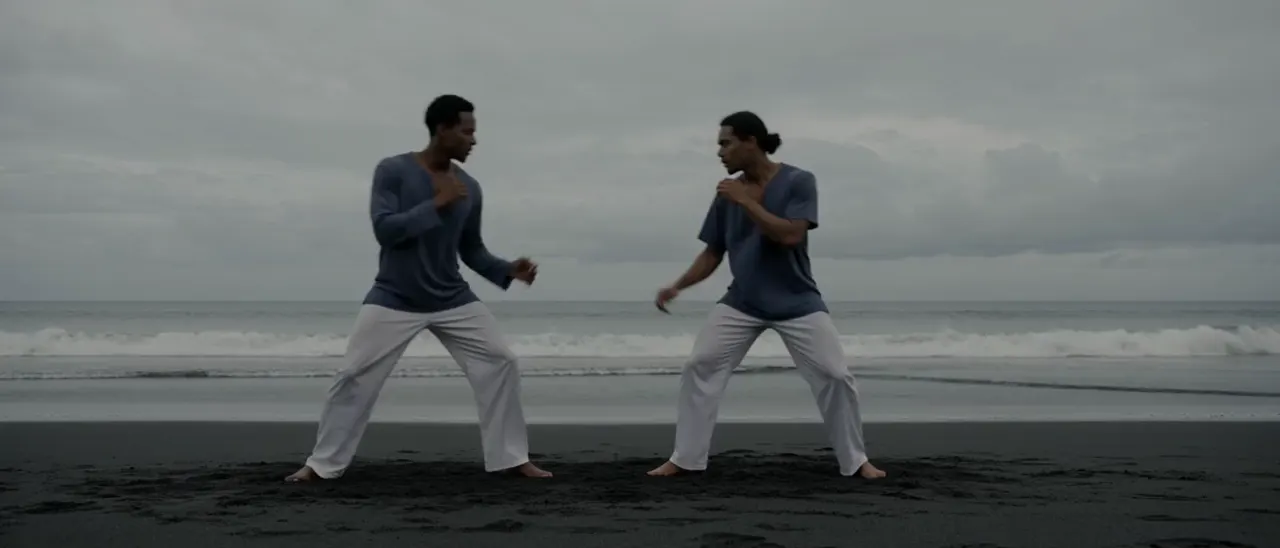
“One continuous wide shot, camera locked off at chest height. On a black volcanic sand beach under a flat silver overcast sky, two capoeira players in loose white trousers and faded indigo tops trade fast moves: one throws a high spinning kick, the other ducks low beneath it and wheels away in a cartwheel, then both spring back up facing each other, swaying in the ginga stance. Wet black sand flicks up from their feet; small grey waves break behind them. Sound: bare feet slapping wet sand, sharp breaths, the surf.”Kling 4.0, 5 s, sound, 160 credits, made on Kling AI
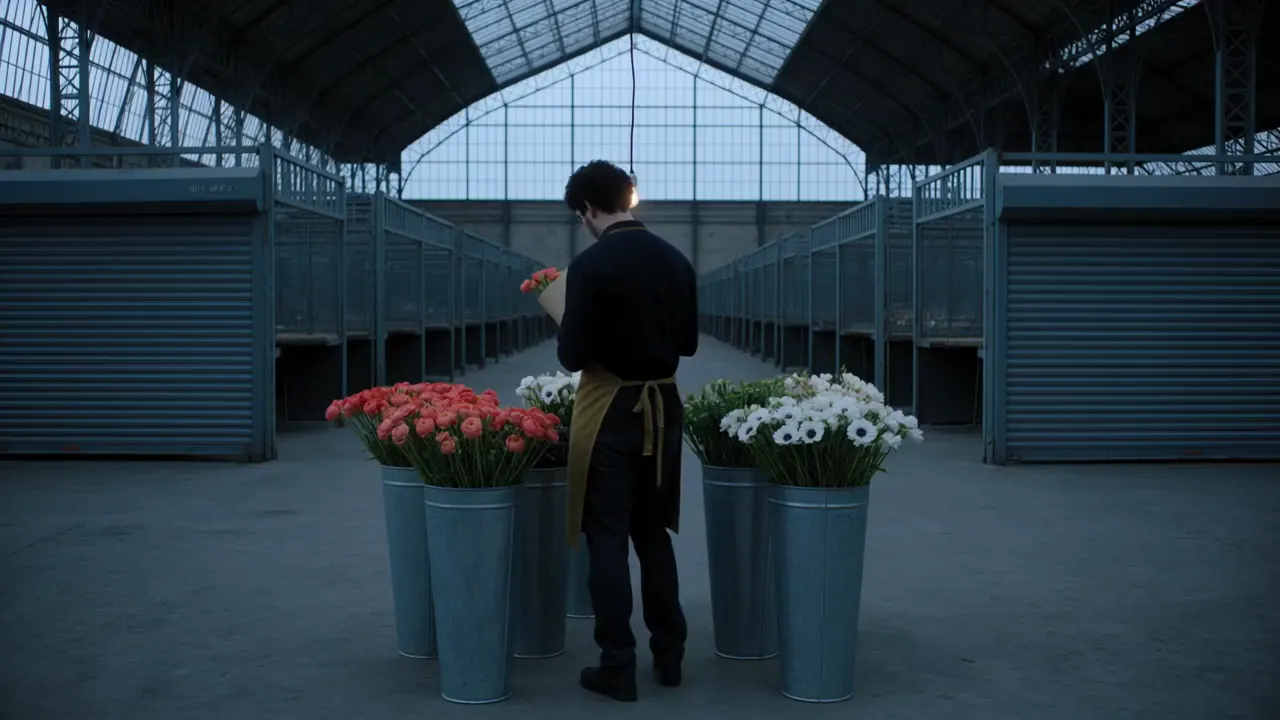
“Single continuous camera move, no cuts. The shot opens wide on a young florist with curly black hair and a mustard canvas apron, standing among galvanised buckets of coral ranunculus and white anemones under the iron-and-glass roof of an empty covered market at first light. The camera arcs a slow half circle around him, from behind his left shoulder round to face him, while pushing in, and ends in a close-up as he looks up from the stems in his hands and says: "First ones in today." Cool blue daylight from the high windows, one warm bulb above the stall. Sound: the rustle of paper and stems, a distant shutter rolling up, his line spoken clearly.”Kling 4.0, 5 s, sound, 160 credits, made on Kling AI
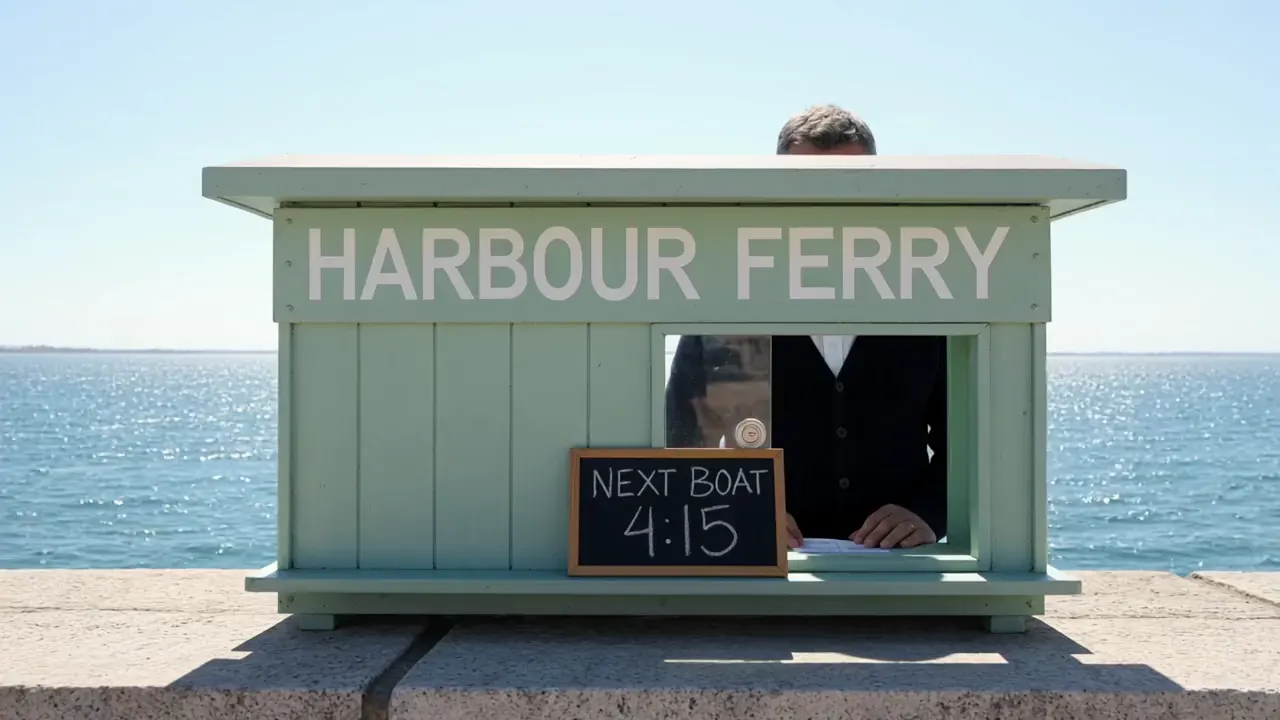
“Slow sideways dolly along a pale mint-green ferry ticket kiosk on a stone quay at hard noon, the sea bright behind it. Painted on the kiosk in large white capitals: "HARBOUR FERRY". A small black chalkboard on the counter reads "NEXT BOAT 4:15" in white chalk. A ticket seller in a navy cardigan slides a paper ticket across the counter. 2-4 s: a subtitle in small white sans-serif, centred at the bottom of the frame: "Last crossing of the summer." Sound: gulls, water slapping the quay. No background music.”Kling 4.0, 5 s, sound, 160 credits, made on Kling AI
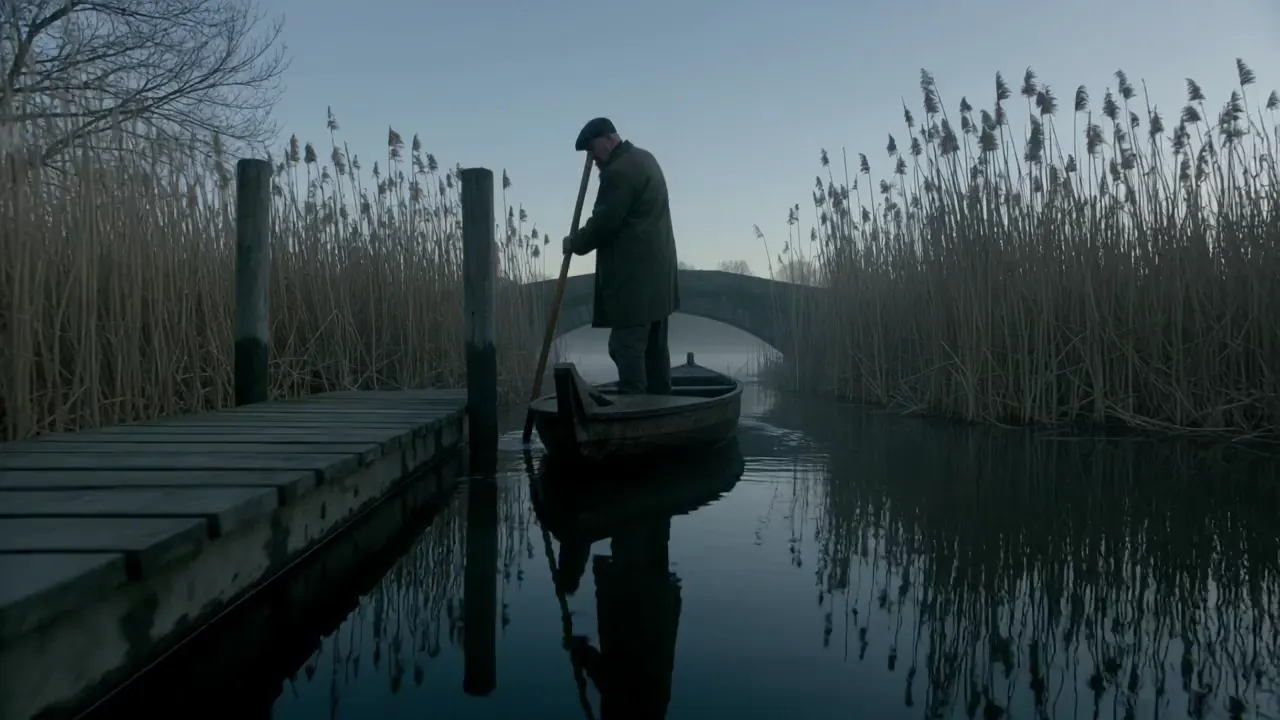
“One continuous take with no cuts, the camera floating just behind and beside the boat the whole time. Blue dawn on a still reed lake, thin mist on the water, film-photograph colour. 0-2s: a ferryman in a heavy dark-green oilskin coat and flat cap pushes a flat wooden punt off from a weathered jetty with a long pole. 2-4s: as the punt glides through a channel in the tall reeds, a grey heron lifts out of the reeds beside him and flaps away low over the water. 4-6s: he ducks under a low, moss-covered stone footbridge and the camera follows him through its shadow. 6-8s: the punt emerges into open water in the first warm sunlight, and a small whitewashed chapel on a wooded island comes into view ahead. Sound: water dripping from the pole, heron wingbeats, the echo under the bridge, one distant chapel bell.”Kling 4.0, 8 s, sound, 255 credits, made on Kling AI
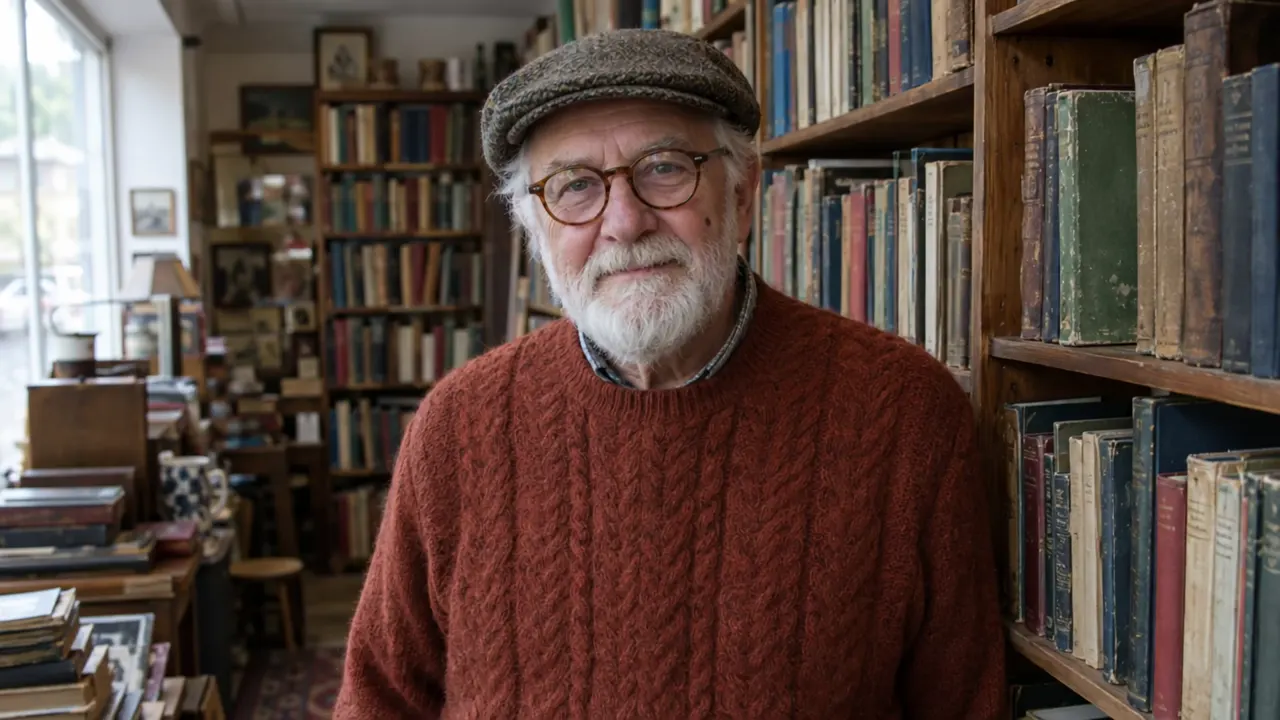
“He takes off his round tortoiseshell glasses and wipes the lenses on his rust sweater, then turns away to the shelf on the right and pulls out a faded green book. He turns back to the camera, puts the glasses back on, opens the book and looks up with a broad smile. The camera holds a steady medium shot with a slight drift. Sound: quiet shop room tone, the book sliding from the shelf, pages turning.”Kling 4.0, photo to video, 8 s, sound, 380 credits, made on Kling AI, input image made with GPT Image 2.5
What you can make with Kling 4.0
Each one comes with the settings and the prompt we would start from, and what it costs. Use it as is or edit it.
made on Kling AI
One 30-second take
Six timed beats, from piping the last flowers to leaving the cake alone in the courtyard, in one unbroken take with every beat in its window. The prompt is from Fuser’s Kling 4 guide. As in Fuser’s run, it did not give the direct-flash snapshot look the prompt asks for: the light is soft daylight. The jacket carries a small, unreadable logo-like mark.
Text to video
1080p
30 s
sound
16:9
“One unbroken handheld take, direct-flash 35mm snapshot look, fine grain, white tile and bright window light. 0-5s: from behind, a young pastry cook in a white jacket and a long black apron pipes the last pale-yellow buttercream flowers onto a small white cake on a scrubbed wooden bench in a narrow tiled pantry, steel bowls stacked on the shelves. 5-10s: she puts the piping bag down, turns the cake once on its plate to check it from every side, and straightens one flower with a fingertip. 10-15s: she lifts the cake on its plate, turns and carries it through the cramped kitchen past hanging ladles and a steaming stockpot, the camera following at shoulder height. 15-20s: she shoulders open a back door into a quiet, sunlit courtyard and walks across the flagstones. 20-25s: she sets the cake down on a weathered table laid for one and steps back to look at it. 25-30s: she wipes her hands on the apron and walks back inside, leaving the cake alone on the table in the sun. Sound: piping bag squeeze, a pot lid rattling, the door creak, birds outside.”
Tip: Open with “One unbroken take” and give each five seconds its own beat (“0-5s: …, 5-10s: …”).
1,410 credits
made on Kling AI
A 15-second take with four steps
Oars off the rack, down the slipway, into the scull, first stroke: one take, in order, rowing the right way. Fuser ran the same prompt and got a single oar; this take has the pair the prompt asks for.
Text to video
1080p
15 s
sound
16:9
“One unbroken handheld take on 16mm film, misty grey dawn, a muted palette of wet timber, slate water and fog with one faded-red accent. 0-4s: inside an old timber boathouse on a still lake, a young woman in a faded red rowing vest and grey leggings lifts a pair of long wooden oars down from a wall rack. 4-8s: she carries the oars on her shoulder down the wet wooden slipway, the camera following behind her at shoulder height. 8-12s: she steps carefully into a narrow white single scull tied at the jetty, sits, and slots the oars into their riggers. 12-15s: she pushes off from the jetty with one hand and takes her first stroke, the scull gliding out into the fog, ripples spreading toward the camera. Sound: creaking boards, her footsteps, water lapping, one distant bird call.”
Tip: Say how many of each prop there are (“a pair of long wooden oars”) and check the whole clip: small props are what drift.
705 credits
made on Kling AI
Fast action between two people
A clean hip throw with each limb staying on the right person, the slap of the landing in the sound. The prompt is from Fuser’s Kling 4.0 vs Kling 3.0 test. The camera stays still instead of the low handheld move the prompt asks for, which Fuser’s take missed too.
Text to video
1080p
5 s
sound
16:9
“Real-time speed, 35mm documentary look, flat daylight from tall paper windows in an old wooden dojo with straw-yellow tatami. Two women judoka, one in a white judogi and one in a deep blue judogi, grip each other's lapels and sleeves. The woman in white steps in, turns her hip under her opponent and throws her in a clean hip throw; the woman in blue rotates over her hip through the air, lands flat on her back with a loud slap of the mat and immediately rolls up to her knees. Camera: low handheld, side-on, following the throw. Sound: bare feet on tatami, a sharp exhale, the slap of the landing.”
Tip: Name who does what by their clothing (“the woman in white … the woman in blue”) so the model keeps the two apart.
235 credits
made on Kling AI
A cinematic wide in 21:9
Two capoeiristas on a black-sand beach in the 21:9 frame, with the kicks and dodges easy to follow. The prompt is from Fuser’s Kling 4.0 vs Seedance 2.5 test, where Kling 4.0 won this round.
Text to video
720p
5 s
sound
21:9
“One continuous wide shot, camera locked off at chest height. On a black volcanic sand beach under a flat silver overcast sky, two capoeira players in loose white trousers and faded indigo tops trade fast moves: one throws a high spinning kick, the other ducks low beneath it and wheels away in a cartwheel, then both spring back up facing each other, swaying in the ginga stance. Wet black sand flicks up from their feet; small grey waves break behind them. Sound: bare feet slapping wet sand, sharp breaths, the surf.”
Tip: Use 21:9 for wide action with two people side by side; there is room for both without cropping a limb.
160 credits
made on Kling AI
A camera orbit and a spoken line
The camera swings half way around a florist and ends close on him as he says “First ones in today.”, with the voice in the same pass as the picture. The prompt is from Fuser’s Kling 4.0 vs Seedance 2.5 test.
Text to video
720p
5 s
sound
16:9
“Single continuous camera move, no cuts. The shot opens wide on a young florist with curly black hair and a mustard canvas apron, standing among galvanised buckets of coral ranunculus and white anemones under the iron-and-glass roof of an empty covered market at first light. The camera arcs a slow half circle around him, from behind his left shoulder round to face him, while pushing in, and ends in a close-up as he looks up from the stems in his hands and says: "First ones in today." Cool blue daylight from the high windows, one warm bulb above the stall. Sound: the rustle of paper and stems, a distant shutter rolling up, his line spoken clearly.”
Tip: Write the line in quotes and say when it comes; put it early so a short clip has room to finish it.
160 credits
made on Kling AI
Signs and subtitles spelled right
The sign, the chalkboard and the subtitle are spelled correctly, as in Fuser’s run of the same prompt. Also as in Fuser’s run, the subtitle stays on screen longer than the prompt asks.
Text to video
720p
5 s
sound
16:9
“Slow sideways dolly along a pale mint-green ferry ticket kiosk on a stone quay at hard noon, the sea bright behind it. Painted on the kiosk in large white capitals: "HARBOUR FERRY". A small black chalkboard on the counter reads "NEXT BOAT 4:15" in white chalk. A ticket seller in a navy cardigan slides a paper ticket across the counter. 2-4 s: a subtitle in small white sans-serif, centred at the bottom of the frame: "Last crossing of the summer." Sound: gulls, water slapping the quay. No background music.”
Tip: Put each piece of text in quotes and say where it sits; add the subtitle in an editor if its timing must be exact.
160 credits
made on Kling AI
Four beats in 8 seconds
The ferryman stays in frame through the reeds, the heron, the bridge and the chapel, and the light turns warm at the end. In Fuser’s run of this prompt the light stayed cold blue throughout.
Text to video
720p
8 s
sound
16:9
“One continuous take with no cuts, the camera floating just behind and beside the boat the whole time. Blue dawn on a still reed lake, thin mist on the water, film-photograph colour. 0-2s: a ferryman in a heavy dark-green oilskin coat and flat cap pushes a flat wooden punt off from a weathered jetty with a long pole. 2-4s: as the punt glides through a channel in the tall reeds, a grey heron lifts out of the reeds beside him and flaps away low over the water. 4-6s: he ducks under a low, moss-covered stone footbridge and the camera follows him through its shadow. 6-8s: the punt emerges into open water in the first warm sunlight, and a small whitewashed chapel on a wooded island comes into view ahead. Sound: water dripping from the pole, heron wingbeats, the echo under the bridge, one distant chapel bell.”
Tip: 8 seconds is the length most published Kling 4 prompts are timed for; keep one beat per two seconds at this length.
255 credits
made on Kling AI, input image made with GPT Image 2.5
A photo brought to life
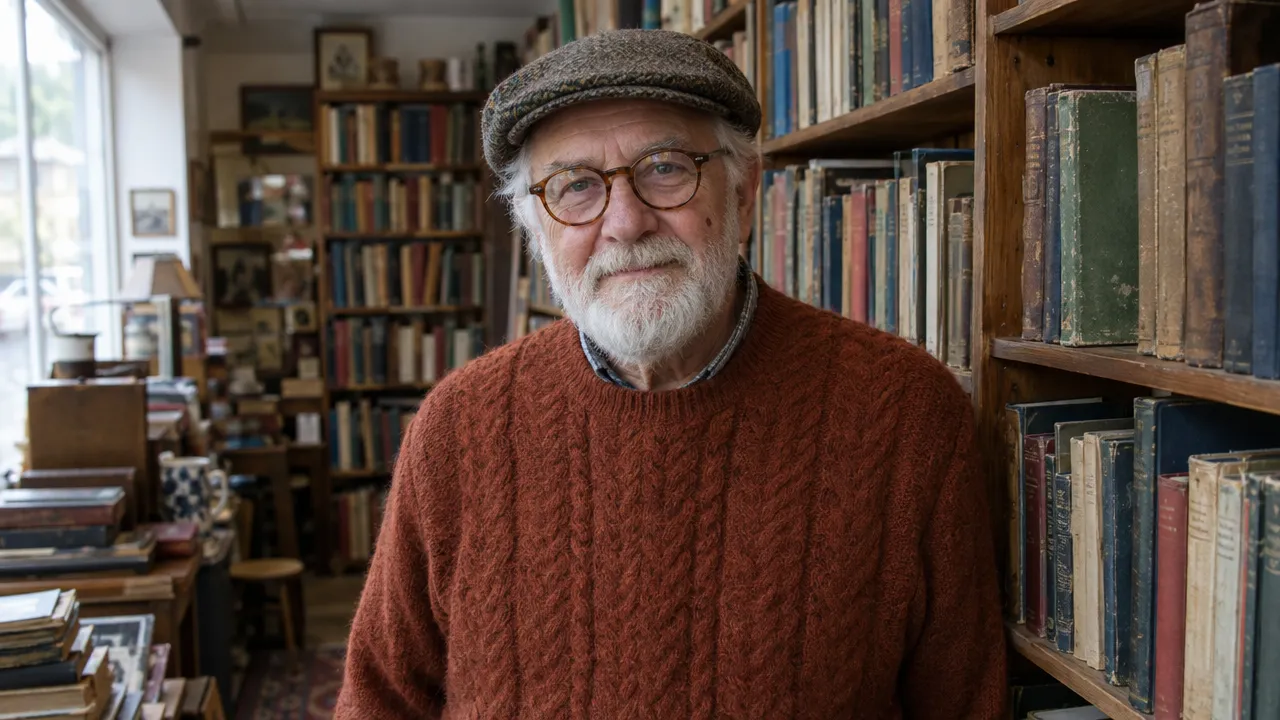
Every step of the prompt happens in order, and the man and his glasses stay as they are in the photo. The prompt is from Fuser’s Kling 4.0 vs Kling 3.0 test; the start image is our own, made with GPT Image 2.5, not Fuser’s.
Image to video
1080p
8 s
sound
16:9
“He takes off his round tortoiseshell glasses and wipes the lenses on his rust sweater, then turns away to the shelf on the right and pulls out a faded green book. He turns back to the camera, puts the glasses back on, opens the book and looks up with a broad smile. The camera holds a steady medium shot with a slight drift. Sound: quiet shop room tone, the book sliding from the shelf, pages turning.”
Tip: Describe what moves and in what order, not the picture: the image already sets the person and the room.
380 credits
What sets Kling 4.0 apart
One take of up to 30 seconds
Kling 4.0 generates up to 30 seconds in a single pass, which Kuaishou calls its headline upgrade. In the independent tests we found, long clips held one take and kept the actions in order: Fuser’s 30-second pastry cook “came back as one take with no cut our scene detection could find, and each beat landed in its window.”
How to use it: Open with “One unbroken take”, then give each beat its own time range, about one beat per five seconds: “0-5s: …, 5-10s: …”. A one-line prompt on a long clip leaves the editing to Kling, which may cut it into several shots.
Speech, effects, ambience and music are generated with the picture in two-channel stereo. Kling lists nine speech languages plus dialects and accents. Testers found its mixes louder than other models’, which helps on a phone speaker.
How to use it: Write each line in quotes, in the language it should be spoken in, and describe the voice: age, tone, speed and emotion. Name the sounds you want (“gulls, water slapping the quay”) and end with “No background music” if there should be no score.
Text in the frame
Signs, chalkboards, title cards and subtitles are a clear gain over Kling 3.0. In Fuser’s kiosk test “the sign, the chalkboard and the subtitle were spelled correctly in every frame”, though the subtitle showed for longer than asked. Background and neon signs can still turn into made-up script.
How to use it: Put the exact words in quotes and say where they sit. For subtitles, Kling’s guide asks for the font size, alignment and how long they stay on screen.
What Kling 4.0 is good at, and where it struggles
Good at
Long single takes: in every independent long-take test we found (Fuser, Voyager, SandBase, The Local Lab, October 2026), 15- to 30-second clips came back as one shot that reached each timed beat in order.
Fast action between people: it won every action round in Fuser’s same-prompt tests against Kling 3.0, Seedance 2.5 and FLUX.3 (judo, capoeira), with limbs staying on the right person.
Directed camera moves: orbits, push-ins and tracking shots follow the prompt; in SandBase’s five-model test it was the only one that swung the camera around a skater.
On-screen text is spelled correctly far more often than on Kling 3.0: signs, chalkboards, title cards and subtitles came out right in Fuser’s and Voyager’s text tests.
Stereo sound and dialogue in nine languages (Chinese, English, Japanese, Korean, Spanish, Portuguese, German, French, Hindi), lip-synced, in the same pass as the picture.
Limits
Short clips cut when you didn’t ask: five of Voyager’s nine 5-second clips contained a cut. Kling makes multi-shot clips by default; start the prompt with “One unbroken take” to keep one shot.
Sound is always on, and the model may add background music; write “No background music” if you don’t want it.
It can drop look words: in Fuser’s tests it kept the scene but swapped a “direct-flash 35mm” look for soft daylight, and made a misty grey dawn darker and cooler.
Small props can double or go missing (a second cloth on the table, one oar instead of two), and hands, liquids and thin objects can deform.
It is slow: testers measured about two and a half to six minutes for a 5-second 720p clip, and longer for 30 seconds.
On zzo.ai it runs at 720p or 1080p, from text or a first frame. 4K, extending a clip, reference images and keyframes are features of Kling’s own app and aren’t offered here.
A good first result with Kling 4.0, step by step
Draft cheap, finish high. Each step shows its settings and cost.
1
Find the take at 720p, 5 seconds
Try the idea at the cheapest setting and change one thing at a time. Start with “One unbroken take” if you want one shot.
720p
5 s
sound
16:9
3 runs × 160 = 480 credits
2
Run the full length at 720p
Write the timed beats and generate the length you need. Most social clips can stop here.
720p
15 s
sound
16:9
475 credits
3
Render the final at 1080p
A 1080p run is a new take, not an upscale of the draft, so it can differ: in Fuser’s tests two of ten re-renders drifted enough to run again.
1080p
15 s
sound
16:9
705 credits
About 1,660 credits ($16.60 at the standard rate) for the whole job. Failed runs are refunded, so they don’t count.
Settings, explained
What each option does and what it does to the price.
Modes
Text to video starts from your words. Image to video uses your image as the first frame and takes its shape; Fuser measured the first frame matching the image almost exactly.
Same price: 160 credits (720p, 5 s)
Resolution
720p for drafts and most social posts, 1080p for finals. 1080p costs about half as much again as 720p.
720p: 160 · 1080p: 235 credits (5 s)
Clip length
From 5 to 30 seconds here. 8 seconds is the length most published test prompts are timed for, so they run as written. Short clips cut more often; give long clips one beat per time range.
5 s: 160 · 30 s: 945 credits (720p)
Audio
Always on, included in the price. There is no switch upstream; ask for “No background music” in the prompt, or mute the clip afterwards.
Aspect ratios
16:9 for the web and YouTube, 9:16 for Reels, TikTok and Shorts, 1:1 for feeds, 21:9 for cinematic wides. Image to video follows the shape of your image instead.
16:9, 9:16, 1:1, 21:9 · no price difference
Kling 4.0 specs
Updated 2026-10-28
Developer
Kuaishou
Released
2026-10-15
Type
Video
Modes
Text to video, Image to video
Clip length
5–30s
Resolution
720p, 1080p
Audio
Always on
Aspect ratios
16:9, 9:16, 1:1, 21:9
Commercial use
Allowed, under our terms
Failed generations
Credits refunded automatically
Starts at
160 ($1.60)
Kling 4.0 price per generation
Credits are charged only when a generation starts, and refunded if it fails. The cheapest option is 160 credits.
Kling’s own user guide for 4.0 and the testers who ran it agree on a few rules:
Describe what the camera sees, not abstract labels. The guide swaps “premium look” for “side backlighting outlines the object’s edges, the background is blurred, and fine matte grain is visible on the surface.”
Start with one sentence that names the subject, the place, the action and the emotion, then add only what changes the result: camera, timing, sound.
Time the beats. For long clips, give each part its own range (“0-5s … 5-10s …”), about one beat per five seconds.
Ask for one take when you want one. Multi-shot is on by default; “One unbroken take” at the start keeps a single shot.
Only two negatives are worth writing: “No subtitles” and “No background music.” Other negatives can make errors more likely, according to Kling.
For speech, write the line in quotes in the language it should be spoken in, and describe the voice.
When a result goes wrong
The usual problems with Kling 4.0, why they happen and what to change.
A one-shot prompt came back with cuts
Why: Kling makes multi-shot clips by default, and short clips cut most often.
Fix: Start the prompt with “One unbroken take, no cuts”, keep the action in one place, and try a longer length.
Music plays even though you didn’t ask for any
Why: Kling adds background music unless told otherwise; its guide names “no background music” as one of only two negatives worth writing.
Fix: End the prompt with “No background music” and describe only the voices and ambience you want.
The look isn’t the one you wrote
Why: Testers found Kling 4.0 keeps the scene but can drop style words such as a film stock or a flash look.
Fix: Describe what should be visible instead of naming the look, as Kling’s guide advises: for a flash look, write out the hard frontal light and the sharp shadows it casts.
An extra prop appeared, or one is missing
Why: Small props can be duplicated or dropped across a long take.
Fix: Name each prop once, say how many there are and where they sit, and check the whole clip before you use it.
Subtitles appear on screen
Why: The model may add subtitles to clips with dialogue.
Fix: Add “No subtitles” to the prompt.
The 1080p version differs from the 720p draft
Why: Each run is a new take; a higher resolution is not an upscale of the draft.
Fix: Keep the same prompt and expect some variation; budget for a second 1080p run on clips that must match.
The run failed or timed out
Why: The model returned an error or took too long.
Fix: Nothing is charged: the credits return to your balance. Try again, or try a shorter length.
Kling 4.0 vs Kling 3.0
Kling 4.0 replaces Kling 3.0 on zzo.ai. In Fuser’s same-input tests (23 October 2026) it won three of four rounds against Kling 3.0: a 15-second take with four beats, a judo throw, and an image-to-video clip where only Kling 4.0 kept every step in order. Start-to-end-frame transitions were a tie.
Up to 30 seconds in one generation, against 15 on Kling 3.0.
Steadier large-scale motion and complex camera moves, according to Kuaishou.
Two-channel stereo sound, always on, with speech in nine languages.
Clearer, more stable text in the frame.
A 21:9 aspect ratio for cinematic wides.
Omni Reference (up to 15 reference assets and 10 keyframes) in Kling’s own app; zzo.ai offers text and first-frame image to video.
Kling 4.0 on zzo.ai costs 160 credits ($1.60) for a 5-second 720p clip with audio. No subscription: buy credits once and they never expire. Depending on resolution and length, a generation costs 160 to 1,410 credits ($1.60 to $14.10 at the standard rate). As low as $1.45 with the $199.99 pack. Failed generations are refunded automatically.
Do I need a subscription to use Kling 4.0?
No. zzo.ai has no subscription: buy a credit pack once and spend it on Kling 4.0 or any other model. Credits never expire.
How long can Kling 4.0 videos be, and at what resolution?
On zzo.ai, Kling 4.0 makes clips from 5 to 30 seconds at 720p, 1080p, in 16:9, 9:16, 1:1, 21:9 aspect ratios.
How much does a 10-second Kling 4.0 video cost?
A 10-second 720p clip with sound costs 315 credits: $3.15 at the standard rate, or $2.86 with the $199.99 pack. There is no subscription.
Can I use Kling 4.0 through an API or in Claude?
Yes. Create an API key in Settings, then use Kling 4.0 from Claude, Cursor or your own code through the zzo.ai MCP server. It draws from the same balance at the same prices as the website.
What is Kling 4.0?
Kling 4.0 is Kuaishou’s AI video model, officially launched on 15 October 2026. It makes clips of up to 30 seconds with stereo sound from text or an image. Kuaishou names three upgrades: steadier large-scale motion, native generation of up to 30 seconds in a single pass, and Omni Reference for combining reference images and keyframes in its own app.
Is Kling 4.0 out? When was it released?
Yes. Kuaishou officially launched Kling 4.0 on 15 October 2026, after a faster Flash version opened to some Kling subscribers on 28 September. zzo.ai runs the full Kling 4.0 model, not Flash.
How long can a Kling 4.0 video be?
Up to 30 seconds in one generation; Kling 3.0 stopped at 15. On zzo.ai you pick one of the lengths shown in the generator, and the price scales with the length.
Does Kling 4.0 make 4K video?
Not on zzo.ai: it runs at 720p or 1080p here. Kling lists 4K with 10-bit HDR as coming soon in its own app.
Does Kling 4.0 add sound, and can I turn it off?
Every Kling 4.0 clip comes with two-channel stereo sound, including dialogue, and Kling has no switch to turn it off; the price includes it. Write “No background music” in the prompt if you don’t want a score, and mute the clip in your editor if you want no sound at all.
Why did my one-shot prompt come back with cuts?
Kling 4.0 splits clips into shots by default. Start the prompt with “One unbroken take, no cuts” and keep the action in one place. Testers found 5-second clips cut most often, so a longer length can help.
Kling 4.0 or Seedance 2.5: which should I use?
In Fuser’s same-prompt tests (23 October 2026, one take each), Kling 4.0 followed action, camera moves and reference photos more closely, while Seedance 2.5 gave the moodier, more atmospheric shot. On zzo.ai Kling 4.0 also costs less per second; compare the prices on both model pages.
Can I use Kling 4.0 videos commercially?
Yes. Videos you generate on zzo.ai are yours to use, including in commercial work, as long as the content itself doesn’t break our terms or anyone else’s rights.